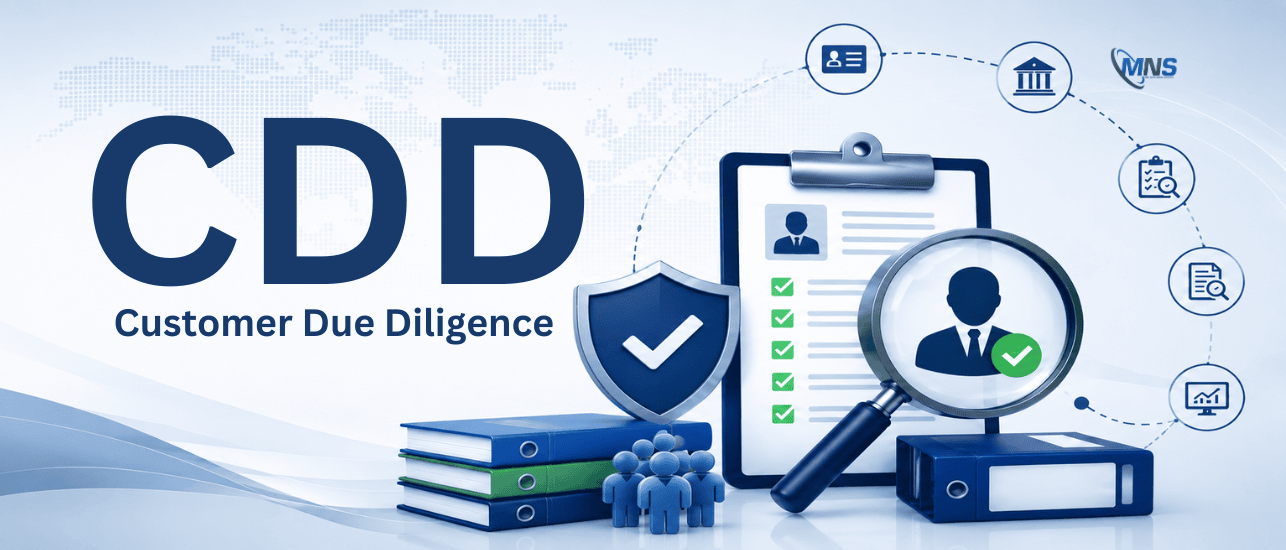
Customer Due Diligence (CDD) refers to how an organization acquires and analyzes an individual’s or organization’s information to determine their level of risk exposure before starting and or maintaining business with them. CDD constitutes a significant part of the Know Your Customer (KYC) and the Anti-Money Laundering (AML) processes. CDD helps to shield an organization from fraud and laundering of money and from the financing of terrorism and the perpetration of other financial crimes.
CDD is comprised of several processes: information collection and verification, identifying the Ultimate Beneficial Owner (UBO) of a business, sanctions and PEP screening, risk level assessment, and the monitoring of the business and transaction activities of the customer. Customer Due Diligence helps a business the fulfill regulatory requirements, lessens the financial and reputational risks, and helps the business to maintain secure and trustworthy relationships with its customers.
These include of: The customer themselves, who must supply specific information in order to transact with the financial institution; Sanctions lists made available by governments or territories; Public data sources, such as corporate listings; Private data sources from third parties. To meet Know Your Customer (KYC) regulations, customer due diligence is crucial. From one nation to the next, or market to market, these differ significantly.
The financial industry plays a critical role in the global economy, handling vast amounts of money and sensitive transactions. Because of this, it is essential to minimize the risk of financial crimes like money laundering, terrorist financing, and fraud. CDD helps prevent these crimes by ensuring that businesses know their customers' identities, their financial activities, and the nature of their transactions. CDD also facilitates regulatory compliance, as many jurisdictions require businesses to conduct these checks under anti-money laundering (AML) regulations. Moreover, CDD plays an essential role in protecting businesses from potential reputational and financial risks.
The first step in CDD is collecting basic customer information, including the customer's full name, address, date of birth, business registration number, and contact details.
Businesses verify the customer's identity using government-issued identification, passports, driving licenses, company registration certificates, or trusted digital verification services.
For companies and legal entities, CDD requires identifying the Ultimate Beneficial Owner (UBO)—the individual(s) who ultimately own or control the business. This helps prevent hidden ownership structures from being used for illegal activities.
Each customer is evaluated based on factors such as industry, country of operation, transaction volume, source of funds, ownership structure, and previous compliance history. Customers are then classified as low, medium, or high risk.
CDD does not end after onboarding. Businesses continuously monitor customer transactions and update customer information periodically to ensure compliance and detect suspicious behavior.
Businesses that lack CDD expose themselves to fraud and penalties for failing to comply with anti-money laundering (AML) regulations. Failure to adhere to AML requirements can cost businesses more than one million euros in countries like Cyprus.
KYC and CDD are frequently mixed up. In contrast to “Know Your Customer,” which has a slightly variable definition depending on the jurisdiction, “Customer Due Diligence” is a precise legal term that applies to all rules. In other words, the list of required KYC checks may vary, whereas CDD entails a precise set of legal requirements.
Different forms of CDD Enhanced due diligence versus simplified due diligence.
In situations where there is a low danger of money laundering, certain regulators permit performing a streamlined investigation known as Simplified Due Diligence (SDD). Businesses may need to carry out enhanced due diligence, or more thorough verification, in situations with increased risks (EDD).
Financial watchdogs don’t always demand that each customer go through the entire verification process. For low-risk clients, such well-known public entities and private persons with steady sources of funding, a reduced or Simplified Due Diligence (SDD) is a solid option.
SDD enables firms to shorten the length of the verification process while still completing all necessary CDD procedures. For instance, SDD may be used when clients trade for less than $100. However, if they go beyond this limit, the entire CDD process will be required.
SDD might not be suitable for some sectors, goods, or jurisdictions.
Numerous questionable instances provide a higher risk of money laundering and must be subjected to additional or Enhanced Due Diligence (EDD). Customers from high-risk nations, PEPs (politically exposed persons), cross-border correspondent ties with a third country, and large transaction sums are some examples of these.
The quantity of checks that businesses conduct distinguishes CDD from EDD. Additional evaluations within EDD might involve asking for more details, checking the sources of money and wealth, gaining senior management approval before beginning a business connection, and other things as well.
Want to give your business Global Validation and Legitimacy?
Apply for LEI Registration with MNS (A Validation Agent appointed by GLEIF for issuance of LEI in India)
Whether the customer is an individual or a business will affect the information-collecting list.
Authenticating a person
Here is a standard starting point for authenticating individuals that may vary depending on the jurisdiction:
Government-issued identification and tax number, together with full name and residential address.
Businesses can use a document given by a trustworthy third party that includes the customer’s photo to confirm the identification of a customer. An ID card or passport can be used as this.
Businesses can check a customer’s residential address using recent (up to six-month-old) utility bills, housing insurance records, municipal taxes, and bank account statements.
Automated verification is the best option for companies that onboard clients remotely. Without the need to add more staff to manage the process, it cuts onboarding time to a few minutes and boosts conversion rates.
Verifying a business
Businesses are required to ask for and confirm specific information before forging a relationship with another organisation. While the precise list can vary between jurisdictions, the following is a standard starting point:
The following information is listed in order of registration:
The objective is to identify the company’s beneficial owners. These are the people who control a considerable amount of the corporation, either directly or indirectly, by directly or indirectly owning more than 25% of it. The beneficial owners must be verified after being found.
| Category | CDD | KYC | AML |
|---|---|---|---|
| Meaning | Customer Due Diligence | Know Your Customer | Anti-Money Laundering |
| Main Purpose | Assess customer risk | Verify customer identity | Prevent financial crimes |
| Focus | Risk evaluation and monitoring | Customer identification | Overall compliance framework |
| Used During | Customer onboarding and relationship management | Identity verification | Entire financial compliance process |
There are three stages to the CDD process:
Step 1: Verifying a consumer comes first
The first step in customer due diligence is gathering fundamental details about the client. The section above contains a list of the necessary information.
It is necessary to acquire original or certified copies of the records that attest to the business’s legal foundation and shareholders in order to receive data about a client that is a company, including information on beneficial owners. They include things like articles of association, memorandums, and certificates of incorporation.
It is necessary to save copies of every document discovered during customer due diligence investigations of both people and businesses.
Step 2: Selecting the appropriate due diligence path
Based on what they know about a consumer, businesses can select between regular, enhanced, and simplified due diligence. For instance, a bank can continue to onboard a customer if it knows that the customer is a government official (a PEP), but an extra check is required.
Step 3: Ongoing surveillance
Once you have a customer on board and a working partnership, the narrative is not over. It keeps doing the monitoring. Given the possibility that a customer’s profile may alter over time, due diligence must be ongoing. They might start a high-risk transaction, end up on a PEP list, or just have their ID expire. Businesses might be better prepared to handle any unexpected crises by keeping a watch on consumer profiles and transactions.
| Feature | CDD | EDD |
|---|---|---|
| Customer Risk | Normal risk | High risk |
| Verification Level | Standard checks | Detailed investigation |
| Information Required | Basic customer details | Additional financial and ownership information |
| Monitoring | Regular monitoring | Enhanced monitoring |
Despite the fact that CDD regulations vary by industry, there are certain key similarities. Learn more about the differences between CDD and other technologies per industry, such as banking, forex, and fintech.
Real papers or selfies that were obtained from the darknet may occasionally be provided by con artists. In these circumstances, even the most trustworthy verification systems could be unable to identify anything suspect because there hasn’t been any document alteration. Businesses can use the additional facial biometric check known as liveness to deter thieves while onboarding consumers remotely. This check makes sure that verification is done on the actual document holder.
To Conclude: Cutting back on customer due diligence’s operating costs
Due diligence on consumers is an expensive endeavour for banks because they must hire teams to onboard customers, look into false positives, and perform manual checks. The cloud-based solutions offered by Swift are designed to make the Due Diligence process less cumbersome administratively.
Identify: The KYC registry offered by Swift establishes uniform standards for data collecting and maintenance and offers bank customers a safe and secure platform to submit KYC information.
Swift’s screening services assist in checking entities for potential exposure to PEPS, penalties, and negative media.
Banks can keep an eye on the danger of penalties on cross-border transfers thanks to Swift’s sanctions screening services.
We collaborate with over 11,000 institutions globally to deliver cutting-edge solutions in the client due diligence arena as the global provider of payments and financial crime compliance solutions to the financial industry.
Depending on the level of risk, customer due diligence can be divided into different categories:
Basic Level of Verification: Standard Due Diligence is performed for low-risk customers. This involves verifying basic customer information, such as their name, address, and financial status, and assessing the general risk level based on public records.
Example: A person opening a savings account in a country with strict anti-money laundering laws might undergo standard due diligence.
In-depth Investigation: Enhanced Due Diligence is required for high-risk customers, such as politically exposed persons (PEPs), customers from high-risk countries, or those involved in high-value or complex transactions.
Example: If a customer is from a country with high corruption risks or is involved in large international wire transfers, enhanced due diligence would include deeper checks, such as investigating the customer’s business sources, purpose of transactions, and links to any illegal activities.
Used for Low-Risk Customers: Some jurisdictions or transactions allow for simplified due diligence for very low-risk individuals or entities. This may involve minimal checks, typically based on the nature of the product or service provided.
Implementing a robust CDD process has several advantages for businesses:
Businesses can strengthen their CDD framework by:
Frequently Asked Questions (FAQ) About Customer Due Diligence
1. What is Customer Due Diligence (CDD)?
Customer Due Diligence (CDD) is a compliance process used by financial institutions and businesses to verify customer identities, evaluate risk levels, understand customer relationships, and prevent financial crimes such as fraud and money laundering.
2. Why is Customer Due Diligence Important?
CDD is essential for businesses to comply with regulatory requirements and prevent financial crimes. It helps companies assess the risk of their clients and ensure that they are not involved in illicit activities, such as money laundering or financing terrorism. By conducting thorough due diligence, businesses protect themselves and their stakeholders.
3. What Are the Key Components of Customer Due Diligence?
Key components of CDD include:
4. How Does Customer Due Diligence Work?
CDD involves gathering and verifying information from customers to assess the potential risk they pose to the business. This may include collecting personal or business identification details, understanding the source of their funds, and reviewing their transaction history. Once collected, businesses use this information to determine the level of risk and whether they need to take further actions, such as enhanced due diligence.
5. When is Enhanced Due Diligence (EDD) Required?
Enhanced Due Diligence (EDD) is required when a business determines that a customer presents a higher risk. This could be due to factors like the customer’s country of origin, business type, transaction volume, or suspicious activities. EDD involves deeper investigation, more frequent monitoring, and additional documentation to ensure that the business is not exposed to financial crime.
6. What are the Benefits of Customer Due Diligence?
The main benefits of CDD include:
7. How Does Customer Due Diligence Relate to Anti-Money Laundering (AML)?
Customer Due Diligence is a key element of Anti-Money Laundering (AML) practices. AML regulations require businesses to identify and assess the risk of their customers to prevent illegal activities like money laundering and terrorist financing. CDD helps ensure compliance with AML laws by thoroughly vetting customers and their financial behavior.
Recommended Read: