Financial ratios are one of the most widely used tools in financial analysis for evaluating the performance and condition of a business. In simple terms, financial ratios are numerical relationships between different financial figures derived from a company’s financial statements. These ratios help convert raw financial data into meaningful insights that can be easily interpreted by investors, lenders, managers, and financial analysts.
A company’s financial statements—primarily the balance sheet, income statement, and cash flow statement—contain a large amount of financial information. However, reviewing individual numbers alone may not provide a clear understanding of a company’s financial position. Financial ratios simplify this process by comparing relevant financial figures to reveal patterns, trends, and relationships that reflect a company’s overall financial picture.
For example, a financial analyst may compare a company’s current assets with its current liabilities to determine whether the company can meet its short-term obligations. Similarly, profitability ratios compare income with revenue or assets to assess how efficiently the company is generating profits. Through such comparisons, financial ratios transform complex financial data into practical indicators of performance and stability.
Financial ratios support comprehensive financial analysis by helping investors, lenders, creditors, and management evaluate profitability, financial health, risk, and operational performance. Investors use them to assess returns, lenders to evaluate credit risk, and management to monitor performance and improve efficiency.
Analyzing ratio trends over time can also reveal early signs of financial strain, such as rising liabilities, declining profitability, or weakening liquidity, enabling stakeholders to take corrective action before problems escalate.
Financial ratios help assess a company’s financial stability by showing how effectively it manages assets, liabilities, and profits. Together, they provide insights into financial health, operational sustainability, debt obligations, and growth potential.
They also support financial modeling, helping analysts use historical data to project future performance and evaluate investment opportunities. Overall, financial ratios transform financial statement data into actionable insights about profitability, efficiency, stability, and financial risk.
A financial ratio is a numerical value that expresses the relationship between two financial figures taken from a company’s financial statements. It is used to evaluate different aspects of a business, such as profitability, liquidity, efficiency, and financial stability. By comparing relevant numbers from the income statement, balance sheet, or cash flow statement, financial ratios help transform raw financial data into meaningful indicators that reflect a company’s financial health.
In simple terms, a financial ratio shows how one financial figure relates to another. Instead of looking at large or isolated numbers in a company’s financial statements, ratios make it easier to interpret financial information by presenting it in a comparative format. This allows financial analysts, investors, and business managers to better understand a company’s financial picture and identify strengths or weaknesses in its operations.
Financial ratios are widely used in comprehensive financial analysis because they provide a structured way to interpret financial data. A company’s financial statements contain many figures such as revenue, expenses, assets, liabilities, and equity. However, analyzing these figures individually may not reveal the true financial condition of the business. Financial ratios address this challenge by comparing key financial figures to evaluate performance, financial risk, and operational efficiency.
For example, one of the most commonly used ratios is the Current Ratio, which measures a company’s ability to meet its short-term financial obligations. It compares current assets with current liabilities using the following formula:
Current Ratio = Current Assets ÷ Current Liabilities
If a company has sufficient current assets to cover its short-term financial liabilities, it generally indicates strong liquidity and lower financial risk.
Another widely used financial ratio is the Profit Margin, which measures how much profit a company generates from its revenue. This ratio helps assess how efficiently a business converts sales into profit. The formula for net profit margin is:
Net Profit Margin = Net Profit ÷ Revenue
A higher profit margin typically indicates better operational efficiency and stronger financial performance.
Financial ratios simplify complex financial data by comparing key figures from financial statements. They provide insights into financial health, liability management, stability, business performance, and potential financial risks, making them valuable tools for analysts and decision-makers.
The MNS Business Information Report delivers a comprehensive analysis of a company, covering both financial and non-financial parameters. It includes key financial ratios such as Profitability, Liquidity, and Efficiency ratios, helping leadership gain a clear and reliable view of a company’s financial health and operational performance.
Apply Here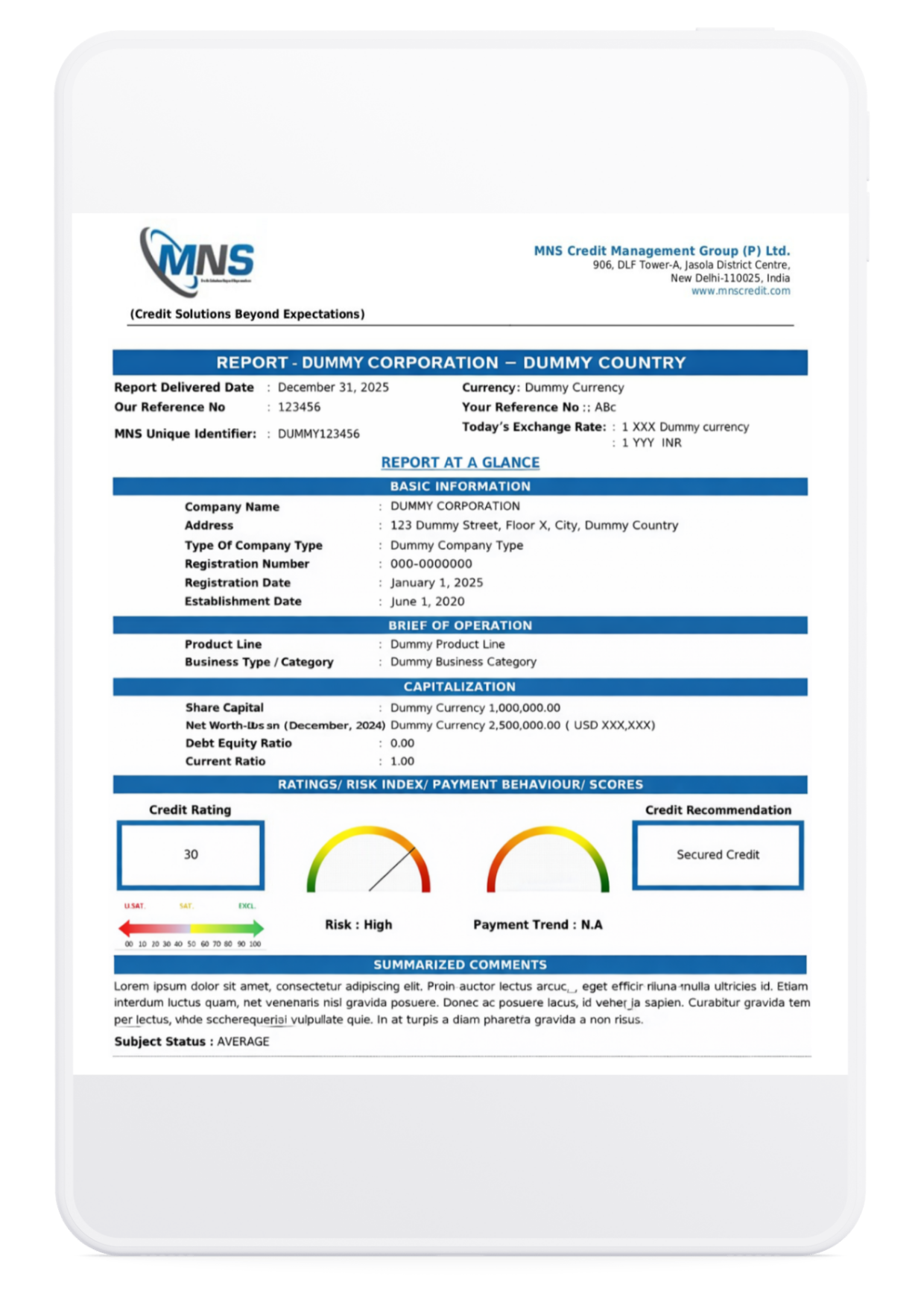
Financial ratios play a critical role in interpreting financial data and turning it into meaningful insights for decision-making. While a company’s financial statements contain numerous financial figures, these numbers alone may not provide a clear understanding of the organization’s financial health. Financial ratios help bridge this gap by allowing stakeholders to evaluate performance, assess financial risk, and gain a clearer view of a company’s financial picture.
By comparing key financial figures from a company’s financial statements, financial ratios provide a structured approach to comprehensive financial analysis. They enable different stakeholders—including investors, lenders, management teams, and financial analysts—to evaluate various aspects of a company’s operations and financial stability.
Investors often rely on financial ratios to determine whether a company is capable of generating consistent profits and delivering returns on investment. Profitability ratios such as profit margin, return on assets (ROA), and return on equity (ROE) provide insights into how efficiently a company converts revenue into profit.
These ratios help investors assess whether a company’s financial performance aligns with their investment goals. A business with strong profitability ratios generally indicates effective cost management, stable revenue generation, and a healthy financial position. As a result, financial ratios allow investors to make more informed decisions when selecting potential investment opportunities.
Financial ratios are also widely used by lenders and creditors to evaluate the creditworthiness of a business before extending loans or credit facilities. Ratios related to liquidity and solvency help determine whether a company has the capacity to meet its financial obligations.
For example, liquidity ratios measure a company’s ability to cover short-term financial liabilities, while leverage ratios assess the level of debt relative to equity or assets. If a company shows high levels of financial liabilities or limited liquidity, lenders may perceive higher financial risk. On the other hand, strong ratio indicators can demonstrate financial stability and increase the likelihood of obtaining credit.
Companies themselves use financial ratios as internal tools to monitor and improve performance. By regularly analyzing ratios derived from their financial statements, businesses can identify areas where efficiency can be improved or where financial strain may be developing.
For example, declining profitability ratios may indicate rising operational costs, while weakening liquidity ratios could signal potential cash flow challenges. Through ongoing ratio analysis, management can detect such issues early and implement strategies to maintain financial stability and support sustainable growth.
Financial ratios are particularly useful for financial analysts who compare multiple companies within the same industry. Since businesses often vary significantly in size, revenue, and asset levels, direct comparison of raw financial figures may not provide meaningful insights.
Financial ratios standardize financial information, allowing analysts to evaluate companies on a comparable basis. By analyzing ratios across similar businesses, analysts can identify industry leaders, assess relative financial strength, and detect potential financial risks.
Overall, financial ratios provide a practical and effective method for understanding a company’s financial position. Whether used by investors, lenders, management teams, or financial analysts, these ratios transform financial figures into valuable insights that support better financial decision-making and a deeper understanding of a company’s financial health.
Financial ratios are grouped into categories based on the aspect of a company’s financial performance they measure. These categories help analysts systematically assess liquidity, profitability, operational efficiency, and financial stability.
By analyzing multiple ratio categories together, stakeholders can gain a comprehensive view of financial health, identify strengths and weaknesses, and assess potential financial risks. Most ratios are calculated from the balance sheet, income statement, and cash flow statement, helping evaluate resource management, profitability, and the ability to meet financial obligations.
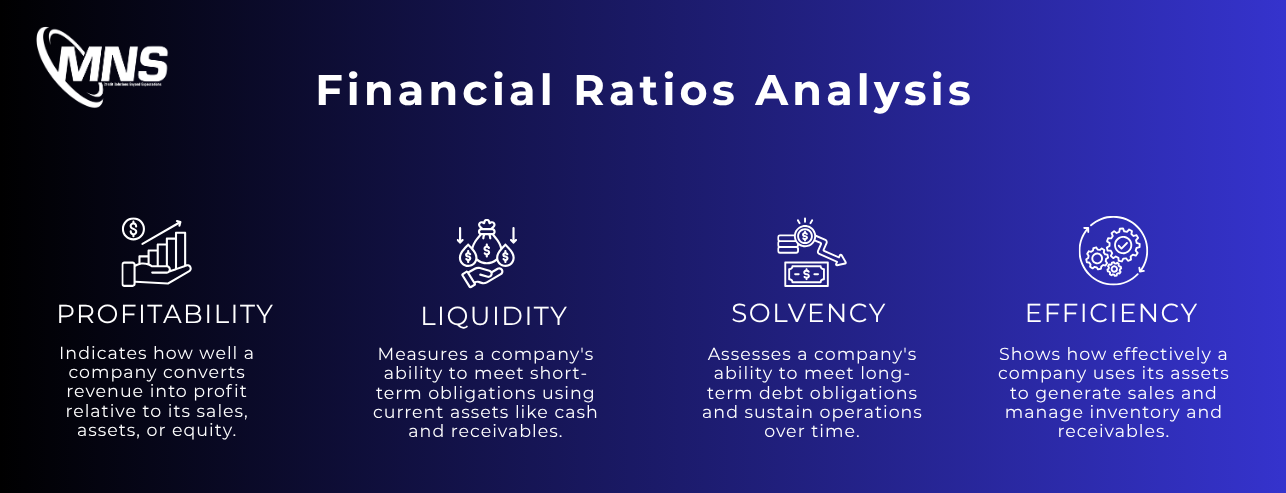
The major types of financial ratios commonly used in financial analysis include the following:
Profitability ratios measure how effectively a business generates profit from its revenue, assets, and shareholders’ equity. These ratios help assess operational efficiency, cost management, and overall earning capacity. For investors, lenders, and business leaders, profitability ratios provide clear insight into whether a company is creating sustainable value and maintaining healthy margins in a competitive market.
Examples of Profitability Ratios:
1. Net Profit Ratio or Net Profit Margin: This ratio indicates the percentage of total income that remains as profit after deducting all expenses, taxes, and losses from total income. It reflects the overall profitability of a company.
PAT = Profit after Tax
Total Income = Revenue from Sales + Other Income
2. Profit Before Tax (PBT Margin): This ratio provides insight into the company's profitability from its core operations before tax liabilities.
PBT = This is the profit a company makes before deducting any taxes. It includes operating income, interest income, and other income, minus interest expenses and other expenses.
Net Sales = Revenue from Sales
3. Return on Capital Employed (ROCE): Where PBT is the same as above and Total Assets comprise current assets (like cash, inventory, receivables) and fixed assets such as tangible and intangible assets.
4. Return on Investment (ROI): Where PBT is the same as above and Net Worth is the same as equity, which includes Share Capital and Reserves & Surplus.
Liquidity ratios evaluate a company’s ability to meet its short-term financial obligations using its current assets. These ratios indicate how well a business can manage working capital, maintain smooth operations, and handle unexpected cash flow pressures. For lenders and management teams, liquidity ratios are critical in assessing financial stability and short-term solvency.
1. Current Ratio: The current ratio is a financial metric used to evaluate a company's ability to pay off its short-term liabilities with its short-term assets.
2. Quick Ratio (Acid-Test Ratio): The quick ratio checks if a company can pay its short-term bills right now — without needing to sell its inventory first.
Think of it this way: inventory takes time to sell. So this ratio only counts the money and assets a company can access quickly — like cash, bank balances, and receivables. That's why it's considered a stricter, more honest test of a company's financial health compared to the current ratio.
Solvency ratios assess a company’s ability to meet its long-term financial obligations and sustain operations over time. These ratios evaluate the balance between debt and equity, indicating how financially stable and leveraged a business is. Investors and lenders rely on solvency ratios to determine long-term risk exposure and the company’s capacity to manage debt responsibly.
1. Debt-to-Equity Ratio: This is a financial leverage ratio that compares a company's total debt to its total equity. It provides insight into how much debt the company uses to finance its assets relative to the value of shareholders' equity.
2. Net Debt to Equity (Times): This ratio measures a company's financial leverage by comparing its net debt (total debt minus cash and bank balances) to its equity. Higher values indicate greater leverage.
3. Net Debt to EBITDA (Times): This ratio compares a company's net debt to its earnings before interest, taxes, depreciation, and amortization (EBITDA). It is used to assess a company's ability to repay its debt using its operating earnings.
Efficiency ratios measure how effectively a company utilizes its assets and resources to generate revenue. These ratios help assess operational performance, asset management, and overall productivity. By analyzing efficiency ratios, businesses and stakeholders can identify areas where processes can be optimized to improve profitability and cash flow.
1. Debtors / Sales (Days): This ratio shows the average number of days it takes for a company to collect payment from its customers after a sale.
2. Payables / Sales (Days): This ratio indicates the average number of days a company takes to pay its suppliers after purchasing inventory or services.
3. Inventory / Sales (Days): This ratio reflects the average number of days inventory remains unsold. Lower values generally suggest faster inventory turnover.
1. Asset Turnover Ratio (Times): This ratio measures how efficiently a company uses its assets to generate sales. Higher values generally indicate better asset utilization and operational efficiency.
2. Inventory Turnover Ratio (Times): This ratio indicates how many times a company's inventory is sold and replaced during a specific period. Higher ratios generally suggest more efficient inventory management.
3. Net Debt / Free Cash Flow to Firm: This ratio assesses a company's ability to repay its net debt using the free cash flow generated by the firm. Lower values generally indicate a stronger financial position and better debt repayment capacity.
Analyzing financial ratios requires more than just applying formulas—it demands accurate financial data, industry benchmarking, and expert interpretation. MNS simplifies this process by integrating financial ratio analysis into its comprehensive Business Information Reports (BIR) and credit evaluation services.
Instead of leaving businesses to interpret raw financial statements, MNS converts complex balance sheet and income statement data into structured insights covering profitability, liquidity, solvency, and efficiency. Each ratio is analyzed in context—compared with industry standards, historical trends, and risk indicators—to provide a clearer picture of financial stability.
For lenders, exporters, and corporate decision-makers, this structured approach reduces uncertainty, enhances credit risk assessment, and supports confident business decisions. By combining financial analytics with on-ground intelligence across 170+ countries, MNS ensures that financial ratio analysis becomes a practical decision-making tool rather than just a numerical exercise.
Calculating financial ratios involves selecting relevant financial statements, applying standard formulas, and interpreting results against industry benchmarks or historical data.
Practical Application:
Financial ratio analysis involves interpreting ratios collectively to understand overall performance, detect risks, and identify opportunities.
Example Insight:
A business may have high profitability but low liquidity, suggesting strong earnings but potential short-term cash flow challenges. Conversely, high liquidity with lower profitability may indicate underutilized assets or operational inefficiency.
Benefits Include:
Financial ratio analysis is used by multiple stakeholders:
Companies that integrate ratio analysis into routine monitoring gain a clear, actionable understanding of financial performance.
Financial ratios and ratio analysis are essential for converting complex financial data into clear insights. By examining liquidity, profitability, solvency, efficiency, and market value, stakeholders gain a comprehensive picture of financial health.
Regular financial ratio analysis allows companies to detect trends early, optimize operations, and make strategic decisions that drive growth and stability.
1. What are financial ratios?
The financial ratios assess the relationship between the different figures present in the company financial statements. Financial ratios serve to analyze the profitability and the financial performance and health of a company.
2. What are the main types of financial ratios?
The five main categories of financial ratios are:
Different types of ratios assess different aspects of financial stability and operational performance of a company.
3. Why are financial ratios important in financial analysis?
Financial ratios are helpful to investors, lenders, and financial analysts as they interpret financial data easily. Simplifying the complex data on financial statements and assessing a company on profitability, financial risk, and operational and financial efficiency is important.
5. How are financial ratios calculated?
A financial ratio is a comparison of two related financial figures. Financial statements, such as the balance sheet or income statement, have figures that can be used to compute financial ratios. An example is the current ratio which is computed by dividing total current assets by total current liabilities.
6. How do financial ratios help in credit analysis?
Financial ratios help lenders and creditors evaluate a company’s ability to repay debts, manage financial obligations, and maintain stable operations before making credit decisions.