How Invoice Discounting Helps Businesses Unlock Cash Flow
Cash flow is the backbone of every successful business. A company may have strong sales, reliable customers, and growing demand, but delayed payments can create financial challenges. When businesses sell products or services on credit, they often have to wait 30, 60, or 90 days before receiving payment.
During this waiting period, businesses still need funds to:
This gap between completing a sale and receiving payment can impact business growth, especially for Micro, Small, and Medium Enterprises (MSMEs).
Invoice discounting is a financial solution that helps businesses overcome this challenge by allowing them to access funds against their unpaid invoices before the customer payment due date.
Instead of waiting for customers to clear invoices, businesses can convert their outstanding receivables into immediate working capital.
Invoice discounting allows businesses to unlock cash stuck in unpaid invoices and maintain a healthy cash flow without waiting for customer payments.
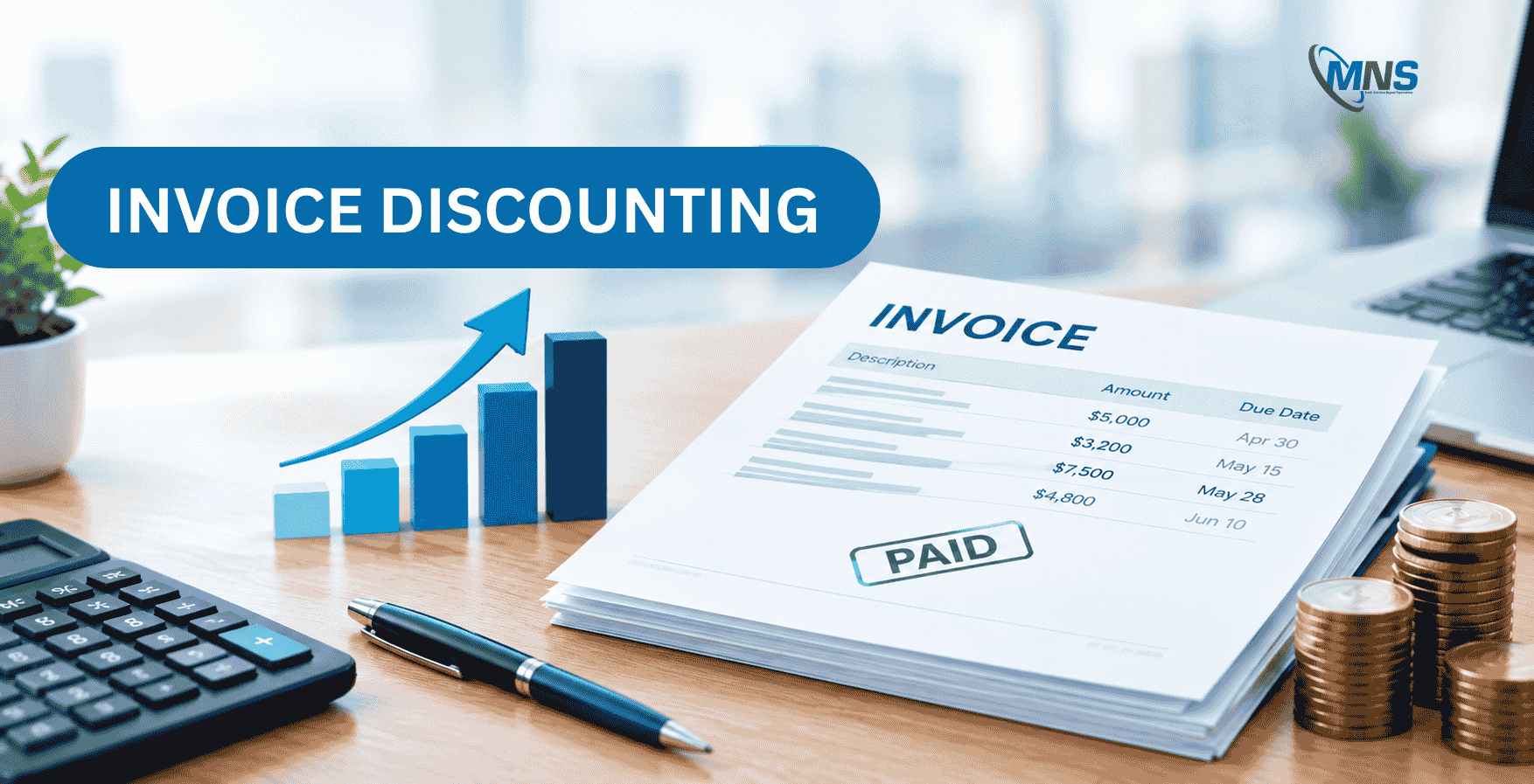
Invoice discounting is a short-term financing method where businesses receive immediate funds by using their unpaid invoices as security.
When a company sells goods or services to a customer, it raises an invoice with a future payment date. Instead of waiting until the customer pays the invoice, the business can approach a financial institution or invoice financing provider to receive an advance against the invoice value.
The financier provides funds after deducting a small discount fee. When the customer pays the invoice on the due date, the transaction is completed according to the agreed terms.
Invoice discounting helps businesses access money they have already earned but cannot use immediately.
Example of Invoice Discounting:
A manufacturing company supplies products worth ₹10 lakh to a corporate buyer with a payment term of 60 days. The company needs money immediately to purchase materials and manage operations. Instead of waiting two months, the business uses invoice discounting and receives funds against the ₹10 lakh invoice from a financing provider. Once the buyer clears the payment, the settlement process is completed.
Access funds against outstanding invoices and improve your business cash flow.
Businesses often experience a working capital gap because revenue generation and cash collection happen at different times.
A typical business cycle looks like:
Manufacture Product → Deliver Goods → Raise Invoice → Wait for Payment
While sales are completed, money remains blocked in accounts receivable.
This creates challenges such as:
Invoice discounting solves this problem by providing early access to funds.
Businesses commonly use invoice discounting for:
Invoice discounting involves three key participants:
The seller is the company that provides goods or services and raises invoices for customers.
Examples:
The buyer is the company that purchases goods or services and has an obligation to pay the invoice.
Large corporate buyers often provide payment terms such as:
The financier provides funds against approved invoices.
Before financing, the provider evaluates:
Step 1: Business Raises an Invoice
The process begins when a business completes a transaction and issues an invoice to the customer.
Example:
A supplier delivers goods worth ₹10 lakh to a buyer with a 60-day payment agreement. The supplier now has an outstanding invoice worth ₹10 lakh.
Step 2: Invoice Is Submitted for Financing
The business submits the invoice to an invoice discounting provider.
The provider reviews important details, including:
Step 3: Invoice Verification
The financier verifies whether the invoice is genuine and eligible for funding.
Factors considered include:
Step 4: Business Receives Advance Payment
After approval, the business receives an advance amount against the invoice.
For example:
Invoice value: ₹10,00,000
Advance received: ₹8,00,000
The difference represents discount charges and applicable fees.
Step 5: Customer Pays Invoice Amount
On the invoice maturity date, the customer makes payment according to the agreed terms.
Step 6: Final Settlement
After receiving payment, the financier completes the settlement process and transfers any remaining balance after deducting applicable charges.
The biggest advantage of invoice discounting is improved liquidity.
Businesses no longer need to wait months for customers to complete payments.
They can access funds quickly and continue normal operations.
Invoice discounting provides faster working capital compared to traditional financing methods.
Businesses can immediately use funds for:
Delayed payments are one of the biggest challenges faced by MSMEs.
Small businesses often depend on regular cash flow to survive and grow.Invoice discounting helps MSMEs:
Unlike traditional loans, invoice discounting is based on outstanding receivables.
Businesses do not always need:
Better cash flow allows companies to focus on growth.
Businesses can:
Businesses can access funds without repeatedly requesting customers for early payments.
This helps maintain professional relationships with buyers.
MSMEs are among the biggest beneficiaries of invoice discounting. Small businesses often supply products to large companies but experience delayed payment cycles.
For example:
An MSME supplier completes an order for a large company and raises an invoice. The buyer agrees to pay after 60 days. During this period, the MSME still needs money to purchase materials and manage operations. Invoice discounting allows the MSME to access funds immediately against that invoice.
This improves:
In confidential invoice discounting, customers are usually not informed that invoices have been financed. The business continues managing customer relationships.
Suitable for:
In public invoice discounting, customers are informed about the financing arrangement. The customer may directly pay the financier.
Businesses can choose specific invoices instead of financing all outstanding invoices. This provides flexibility.
The business remains responsible if the customer fails to pay.
The financier takes responsibility for certain payment risks depending on the agreement.
| Invoice Discounting | Invoice Factoring |
|---|---|
| Business manages collections | Provider may manage collections |
| Usually confidential | Usually disclosed |
| Mainly provides funding | Funding + collection services |
| Business controls customer relationship | Provider may interact with customers |
| Invoice Discounting | Business Loan |
|---|---|
| Get cash against unpaid invoices | General business funding |
| Faster access to funds | Longer approval process |
| Usually no collateral required | May require collateral |
| Flexible working capital solution | Fixed repayment structure |
Before choosing invoice discounting, businesses should understand the associated costs.
Common charges include:
1. Discount Fee
The main cost charged by the financier for providing funds.
2. Processing Charges
Some providers charge administrative or platform fees.
3. Service Charges
Additional charges may apply depending on the agreement.
The total cost depends on:
Businesses generally require:
Requirements may vary depending on the financing provider.
Invoice discounting is suitable for businesses that:
Common users include:
Technology has transformed invoice financing.
Modern digital platforms allow businesses to:
Digital invoice discounting makes financing faster, simpler, and more accessible for small businesses.
1. Understand the requirement
We first understand the client's business, outstanding invoices, buyer details, payment terms, required funding, and whether the invoices are domestic or export.
2. Evaluate the case
We check the basic eligibility of the company and, importantly, the quality and creditworthiness of the buyer/debtor.
3. Identify the right financier
MNS Credit Management Group approaches suitable banks, NBFCs, and factoring companies from its financing network and identifies where the client's invoices can be financed on the best possible commercial terms.
4. Arrange the required documentation
We guide the client on the documents required and coordinate their submission to the financier.
5. Negotiate/coordinate commercial terms
We help obtain and compare the available terms such as:
6. Coordinate with the financier
Once the case is submitted, MNS coordinates between the client and financier, handles queries, arranges discussions/meetings, and helps move the case through the underwriting process.
7. Help the client get funded faster
After approval, the financier funds the eligible invoice, allowing the client to receive working capital before the buyer's actual payment due date.
Client has ₹10 lakh outstanding invoice → Client approaches MNS → MNS finds the suitable financier → MNS coordinates documentation & underwriting → Financier discounts the invoice → Client gets funds upfront.
So, MNS Credit Management Group's value is not just referring the client. We help the client find the right financier, structure the transaction, obtain competitive terms, coordinate documentation, and facilitate the transaction until funding.
Conclusion:
Why Invoice Discounting Is a Smart Financial Solution
Delayed payments can slow down even successful businesses. Companies may have strong sales but still struggle when money remains blocked in unpaid invoices. Invoice discounting provides a practical solution by allowing businesses to unlock working capital from their outstanding invoices.
With benefits such as:
Invoice discounting has become an important financial tool for businesses of all sizes, especially MSMEs. For companies looking to maintain liquidity and expand operations without waiting for long payment cycles, invoice discounting offers a smarter way to manage business finances.
Frequently Asked Questions:
1. What is invoice discounting in simple words?
Invoice discounting is a method where businesses receive money against unpaid invoices before customers make payments.
2. Is invoice discounting a loan?
No. Invoice discounting is a receivable-based financing solution where businesses use invoices to access funds.
3. How does invoice discounting improve cash flow?
It helps businesses receive payment earlier instead of waiting for customers to complete their payment cycle.
4. Is invoice discounting useful for MSMEs?
Yes. MSMEs can use invoice discounting to manage delayed payments and maintain working capital.
5. What is the difference between invoice discounting and factoring?
Invoice discounting mainly provides financing while businesses usually manage collections. Factoring may include collection services by the provider.
6. What documents are required for invoice discounting?
Businesses typically need invoices, registration documents, GST details, PAN, and bank information.